
Connected teams
Digital toolbox talks: connect the discussion, record and follow-up
Organize digital toolbox talks around reviewed topics, understandable discussion, accurate participation records and owned follow-up.
By Reldro · · 10 min read
What makes a toolbox talk digital?
A digital toolbox talk uses software to prepare or distribute discussion material and retain a record of the session and follow-up. It should still be a conversation about the work, not a screen that replaces questions. The useful record explains what was covered, which version was used and what remains unresolved.
For construction contractors, talks can help communicate changes, reinforce reviewed procedures and identify questions before work. They do not automatically satisfy a training requirement, establish competence or authorize a specialist task. Your responsible team determines which instruction, training and assessment the actual work requires.
This guide focuses on digital documentation and handover. The existing topic-preparation article covers choosing relevant talking points and verified templates. Together, they help you avoid a library of generic talks with no connection to today's site conditions.
Choose the discussion from a real planning question
Ask what has changed in the work, location, equipment or neighboring activity. Select approved material that addresses the question and confirm its current version. A topic chosen only because it has not appeared recently may be less useful than revisiting a condition the team is actually encountering.
Write a short purpose before building the session: what should people be able to identify, explain or ask about afterwards? Keep the purpose narrow enough for a discussion and recognize when a fuller course or qualified demonstration is needed.
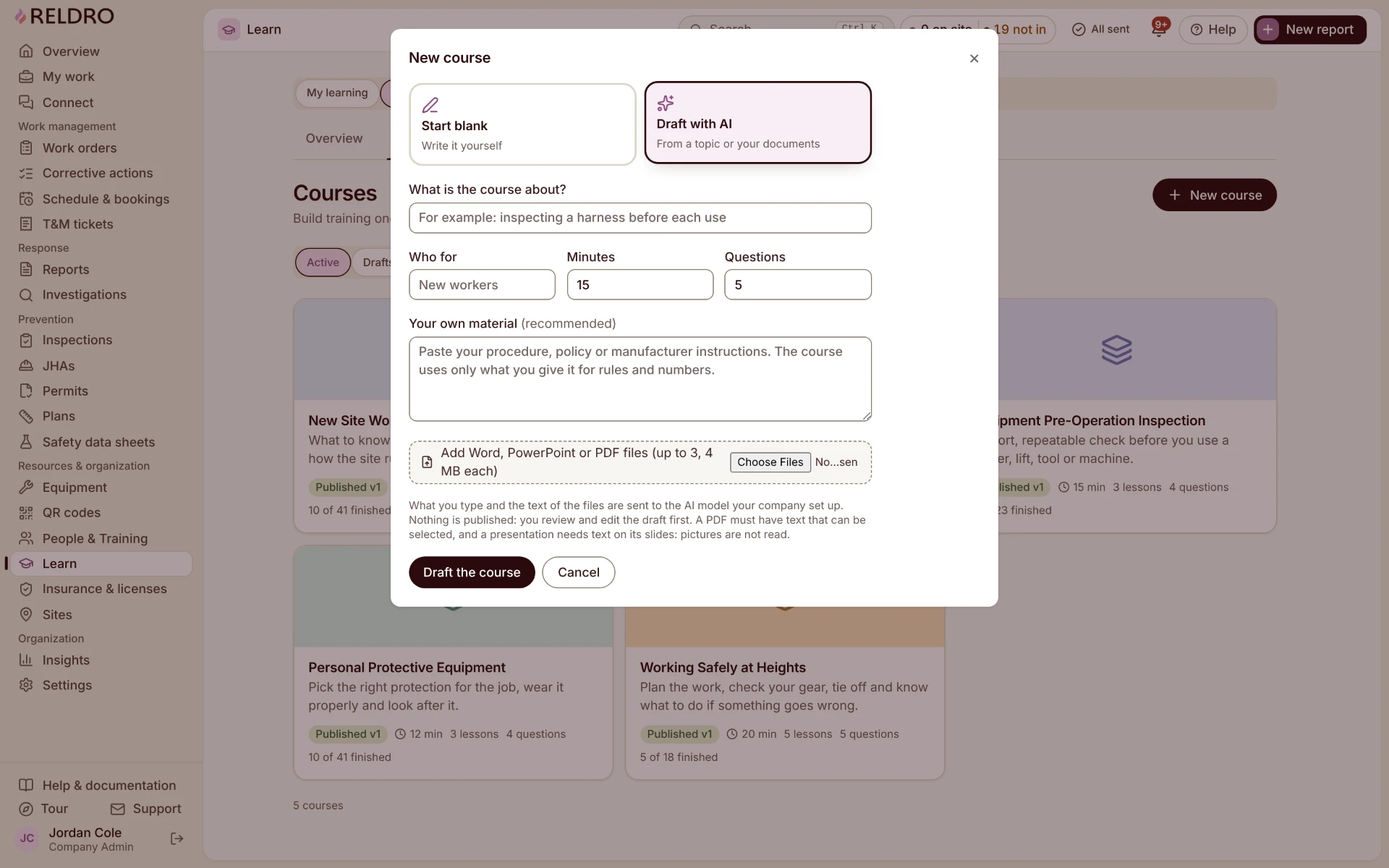
Reldro AI can draft a toolbox-talk outline from a topic and approved material when enabled. The reviewer must check the content, remove unsupported detail and adapt it to the actual work. A generated outline is not a certified training package or approved technical instruction.
Keep the source beside the discussion material
Identify the procedure, course or template used, with its title and version. Link it where the team can find it through the appropriate access arrangement. A summary should not become the only remaining copy of the instruction it describes.
For task-related discussion, retain the JHA, permit or work-order reference where relevant. Those records have different purposes. A talk can explain how to find a task plan, but attendance at the talk should not silently become a JHA signature or a permit approval.
Use real template detail pages where they fit the subject. Review their content against your company's procedures before delivery. Public viewing does not establish free download access or prove a template meets every requirement for your task.
Plan the record before the session
Decide which participation and delivery information your company needs and who will record it. A useful administrative record may identify the project, date, topic, source version, facilitator, participants and follow-up questions. This is an organizing suggestion, not an OSHA-mandated attendance form.
Make it possible to distinguish people who attended, people assigned later learning and people not present. Do not mark an absent worker as having received the discussion merely because their name appears on a team list. If someone needs a separate briefing, record that actual delivery through your process.
Confirm the software's attendance and signature capabilities before promising them. Reldro's supplied material confirms toolbox-talk drafting and Learn course assignments and completion records; this guide does not claim a dedicated automatic toolbox-talk attendance register or signatures inferred from presence.
| Record or decision | What to establish | Who reviews it |
|---|---|---|
| Topic material | Current reviewed source and purpose | Facilitator and content reviewer |
| Participation | People actually involved and delivery context | Session record owner |
| Understanding | Appropriate questions or assessment | Qualified trainer where needed |
| Open question | Uncertainty and next responsible person | Supervisor or relevant reviewer |
| Follow-up | Assigned outcome and completion review | Action owner and verifier |
An example after the work location changes
Illustrative administrative example: a concrete contractor's planned work moves to another area. The supervisor chooses reviewed material that explains how the team will find the current task plan and raise unanswered questions about the new location. They retain the source and relevant assignment reference.
During the discussion, a worker asks whether yesterday's plan still applies. The supervisor records the question and refers it to the responsible reviewer rather than inventing an answer to keep the session short. The session record shows what was covered and what still needs confirmation.
A teammate who arrives later receives the relevant instruction through the appropriate process. Their record identifies the delivery actually completed, not attendance at the earlier session. If the task plan is revised, its required reviews remain separate from the talk record.
The point is a clear handover, not a flawless attendance percentage. An unanswered question can be a useful outcome when it reaches the right owner before work decisions are made.
Make the discussion understandable
Ask which language and format help workers understand the material. Do not infer reading preferences from names or nationality. Use the approved words for equipment and site arrangements, and clarify unfamiliar terms instead of reading a longer script.
OSHA's US training-policy interpretation says required training must be presented in a manner employees can understand, including appropriate language and vocabulary. That does not mean every informal toolbox talk fulfills a particular training obligation. Your training lead identifies the requirements relevant to the work.
Reldro supports company and worker language preferences. Optional AI content translations show the original alongside the translated material, and translated safety instructions remain marked not reviewed until a person checks them. Have the appropriate reviewer confirm technical meaning and keep the source accessible.
Use questions that expose uncertainty
A question such as do you understand can end the discussion without revealing a gap. Ask something specific to the purpose: where would you find the current assignment, who would answer a change question or which reviewed document applies? For skills or technical knowledge, use the appropriate qualified assessment process rather than invent a generic test.
Make room for people to say they are unsure. Record the point that needs explanation and the person responsible for answering it. A signature is not a substitute for the relevant understanding check, and completing a short discussion is not proof of competence.
If the material needs correction, identify the version delivered and the follow-up clarification. Do not silently overwrite it and imply the team heard the revised wording. An accurate record helps a later reviewer understand what information reached the field.
Connect unresolved points to the next work record
After the discussion, identify questions, actions and any further instruction needed. Give each a named owner and a suitable place to record the outcome. A list of questions in a session note can be useful, but it is not the same as assigned follow-up.
Use the relevant work order, corrective action or reviewed task-plan process where appropriate. Keep urgent concerns on the site's immediate-response route. Do not postpone a required response until someone tidies the talk notes.
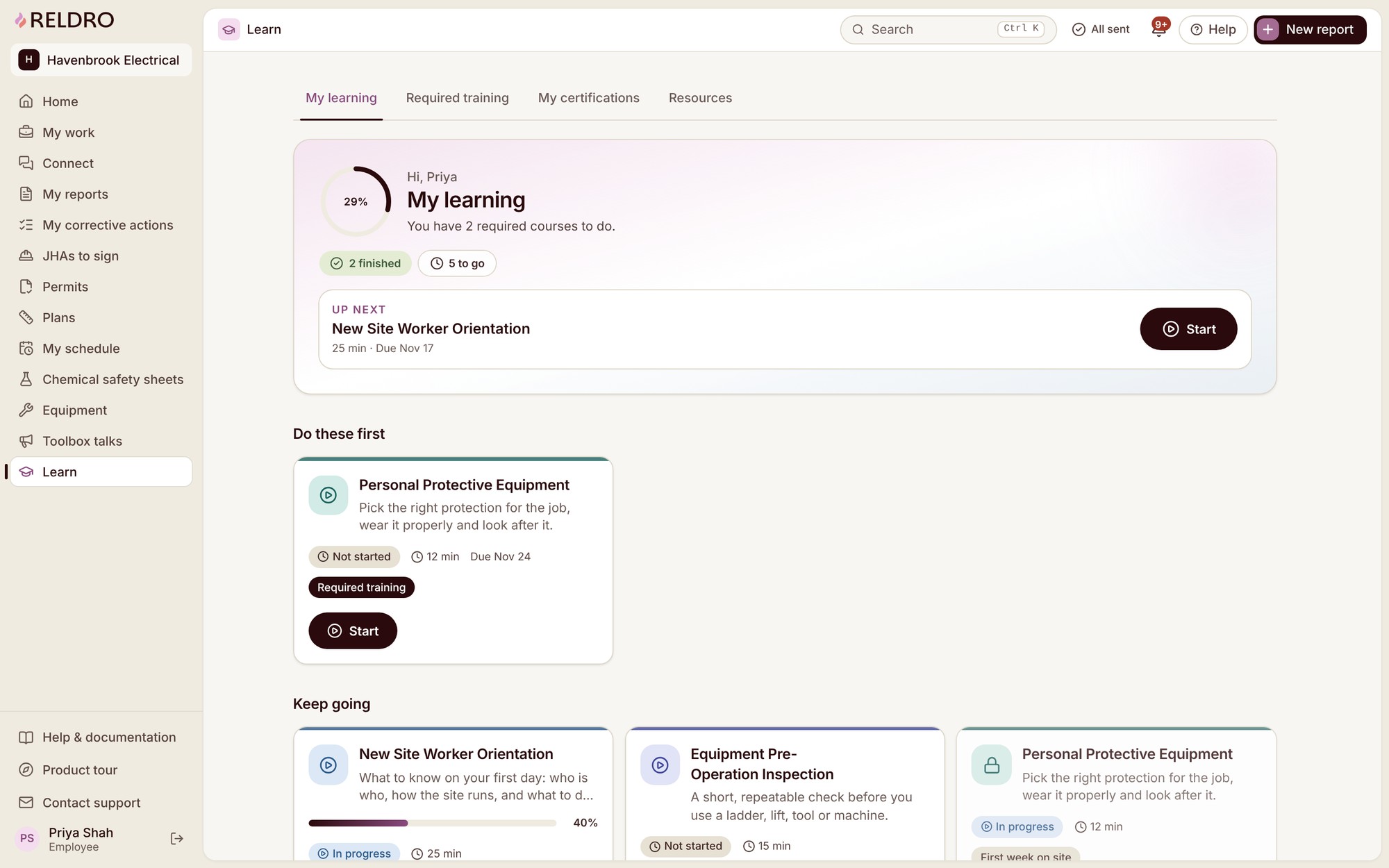
Reldro Connect can carry project discussion, while work orders and corrective actions retain assigned work. Learn provides courses and completion records for training that belongs in a course workflow. Choose the record that fits the purpose rather than call every activity a toolbox talk.
Evaluate digital tools with one ordinary session
Prepare a session from reviewed material, deliver it to a representative team and retain the actual record. Ask another supervisor to find the topic, version, participants and unanswered questions. If they cannot tell what happened without calling the facilitator, improve the record structure.
Check phone readability, access permissions and the process for people who were absent or need another language. Confirm whether your chosen tool supports the attendance, export and retention requirements your company has; do not infer those features from a generic learning dashboard.
You can use a Reldro trial to evaluate the preparation, learning and follow-up portions of the workflow. Be explicit about which parts you are testing and which documentation still follows another established process.
Keep attendance, learning completion and acknowledgment separate
Your organization may record a discussion, assign a course and request a task-plan acknowledgment around the same work. Those records can support one another, but they answer different questions. Who joined a talk is not the same as who completed a course or signed the current JHA.
Use labels that accurately describe the activity. If someone receives a later briefing, record that event rather than add their name to the earlier attendance list. If a course is assigned after an unanswered question, retain the assignment and completion as learning records. Neither should erase the original session note.
Confirm whether the software actually captures the attendance method your company uses. A worker appearing on a site roster or clicking a message reaction does not establish participation in a particular session. This guide deliberately does not claim automatic toolbox-talk attendance in Reldro where the supplied material does not verify it.
When reporting totals, explain whether you are counting sessions, people present, course completions or acknowledgments. A single percentage combining those measures may make a presentation simpler while making the underlying information less reliable. Choose the measure that fits the review question.
Handle revised material and later briefings honestly
A talk may reveal that a source instruction is unclear. Record the question and refer it to the responsible reviewer. If the approved material changes, identify the revised version and which people need the new information. Do not just replace the file and imply everyone heard the corrected wording.
Retain the source used for the original discussion and the later clarification or briefing. That history helps a supervisor understand what was communicated and when. It also avoids treating an earlier attendance signature as acknowledgment of material that did not exist at the time.
For a mixed-language team, review the changed technical meaning in the relevant language and keep the original available. A translation update should not become an automatic assertion that every participant understood the new instruction. Your trainer or supervisor uses the appropriate understanding checks.
During a trial, test an ordinary content correction and a later-arriving teammate. Ask a reviewer to find the version used for each delivery and the remaining question. If the tool cannot support the required record directly, define the complementary process honestly instead of claiming the gap has disappeared.
Review whether the discussion changed the next handover
After a series of sessions, ask whether questions reached the right person and whether agreed follow-up became visible in the work records. A useful discussion may produce an unresolved question that prevents an unsupported assumption. That outcome should not be treated as a failure simply because the session did not finish with every answer.
Look for repeated topics whose source remains unclear, questions without owners and sessions that copy old participant lists. Those are documentation and process gaps, not proof about a worker's attitude or ability. Review them with the people who prepare and receive the material.
Choose improvements that address the specific gap: clearer source references, a better question route or separate completion records for formal learning. Avoid adding more mandatory fields merely to make the form look thorough. The field team needs a workable discussion and the office needs an accurate record.
Keep the review proportionate to the activity and requirements your training lead identifies. A toolbox talk is one communication method within a wider safety and learning process. It should not become the label used for every briefing, assessment or technical approval.
Common documentation questions
Does a digital toolbox talk replace required training? Not automatically. Your applicable requirements and training lead determine what is needed for the task.
Can you reuse the same talk? Reuse reviewed material when relevant, then check the current work and source version. Repeating a useful topic is different from copying a previous attendance record.
Does site check-in establish attendance? No. Presence at a site and participation in a particular discussion are different records.
Should AI deliver the final safety advice? No. Use drafts as preparation aids and have responsible people review the content and answer questions through the appropriate process.
The takeaway
Keep digital toolbox talks tied to reviewed material, actual participation and a clear route for questions. A documented discussion supports communication; it does not prove competence or replace required training.
Sources and further reading
References for this article, published November 11, 2026. Product scope and requirements can change. Confirm details with the provider and your safety team. Guidance from a specific jurisdiction may not apply to your construction project.