
Reporting
Construction incident management software: keep records and response connected
Organize construction event records from initial observations to investigation findings, assigned actions and verification, with human decisions at every stage.
By Reldro · · 10 min read
What is construction incident management software for?
Construction incident management software helps responsible teams organize information about events, retain the response record and connect investigation findings to follow-up. Its role is record handling and coordination. It is not an emergency service, a clinical tool or an automatic source of legal reporting decisions.
For contractors, event information may arrive through a phone call, a supervisor's notes, photos or a field report. The practical challenge is keeping the source, time, location and uncertainty clear while the appropriate people respond. A system should preserve those distinctions instead of turning the first description into a definitive finding.
This article uses incident management as a software category. For visible field-record wording, Reldro uses safety concern and related reporting terms. The process below is administrative guidance; site response, notification obligations and technical decisions require the authorized people and applicable procedures.
Keep immediate response separate from documentation
If someone faces immediate danger or needs emergency assistance, follow the site's emergency and escalation arrangements. Do not delay action to finish a form, take a photo or wait for a software notification. The record can support the later review, but it does not substitute for the required response.
Name the roles responsible for receiving ordinary reports, directing the response and determining whether further notifications or investigation are required. Those roles may differ. A person who can enter a field record is not necessarily authorized to make a reporting determination or contact a regulator on the company's behalf.
Write down the information handover: who was informed, when, through which route and what still needs confirmation. Avoid claiming that an automated alert proves a person read or acted on the information. Test receipt and escalation arrangements through your company's process.
Capture observations without filling gaps with assumptions
Record the site, location, date and time, the person providing information and what they actually observed. Distinguish the time of an event from the time it was reported. If a detail is uncertain or secondhand, label it rather than invent precision.
Preserve relevant source material under your company's privacy, retention and evidence-handling arrangements. A photo, note or document may need context to be useful. Do not collect unnecessary personal information or alter evidence simply to make a record look complete.
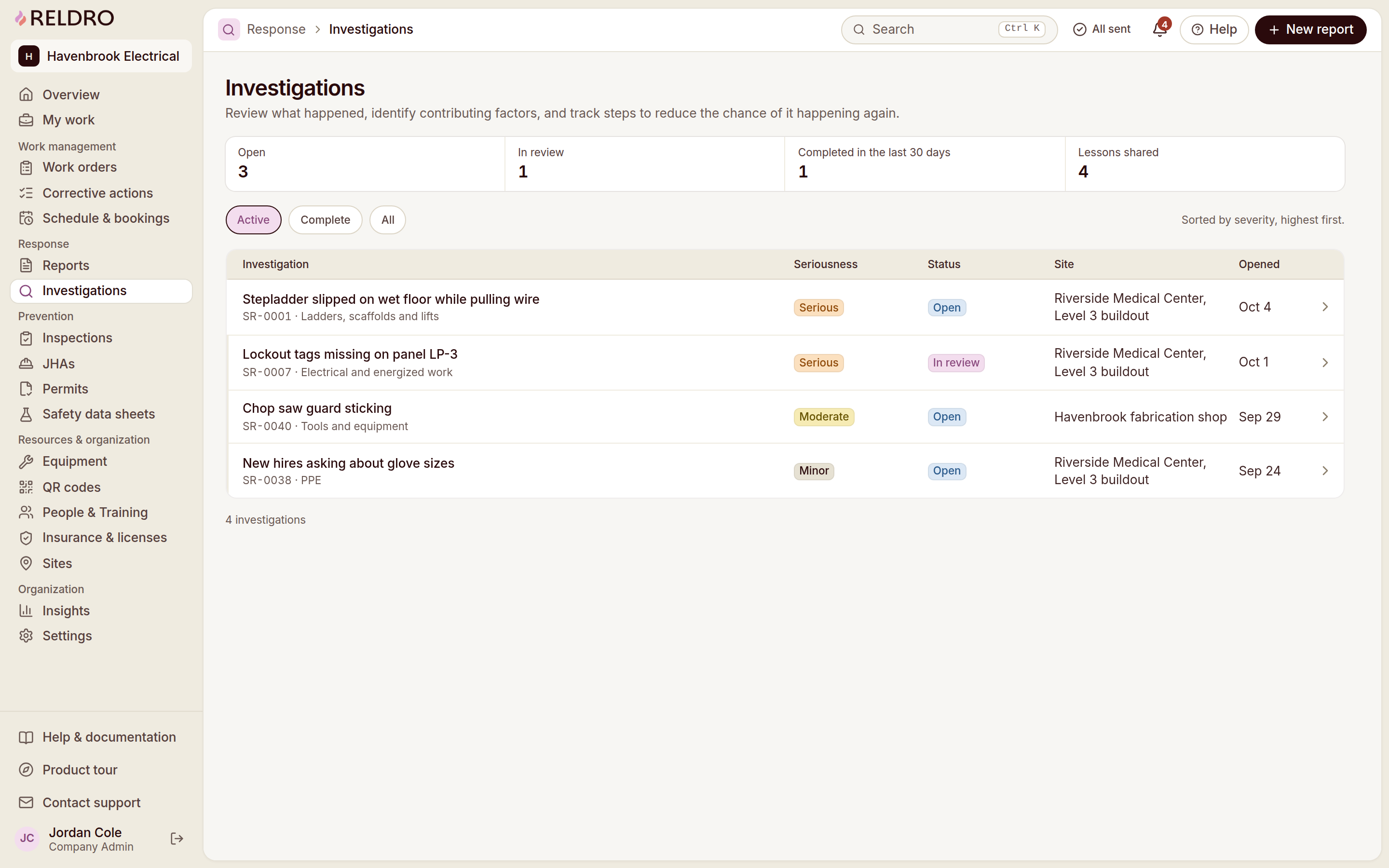
Reldro field reporting retains notes, photos and location context, while investigation records keep facts, sequence and supporting evidence together. Evaluate whether the reviewer can identify which information came from which source. A polished summary is not a substitute for that traceability.
Build a timeline that separates evidence from interpretation
A timeline helps reviewers understand the recorded sequence. Identify each entry's source and distinguish confirmed facts, reported observations and unresolved questions. Chronological order alone does not show causation.
When accounts differ, keep the difference visible and ask the appropriate reviewer to resolve it through the investigation process. Do not select the most convenient version because it fits the expected story. Corrected notes should explain what changed without losing the original record.
OSHA's incident-investigation material encourages examining underlying causes rather than focusing only on blame. It is a useful reference for investigation principles, not a universal reporting standard. Your competent response team chooses the methods applicable to the event and work.
| Record or decision | What to establish | Who reviews it |
|---|---|---|
| Initial observation | Known facts, source and uncertainty | Reporter and reviewer |
| Response record | Who was informed and what was directed | Authorized response lead |
| Investigation | Evidence, sequence and reviewed findings | Competent investigation team |
| Action | Expected outcome and responsible owner | Action reviewer |
| Closure | Review basis and any outstanding follow-up | Authorized closer |
An example with an unresolved sequence
Illustrative record-handling example: a supervisor receives a report that a worker slipped near a wet area. One note gives an approximate time, while a later message describes when the concern reached the office. Those are different timestamps, not conflicting proof about the event by themselves.
The reviewer retains both sources, identifies the uncertain event time and records questions for the authorized investigation team. They do not write that the wet area caused the slip simply because it appears in the description. Observed conditions, contributing factors and findings require separate evaluation.
If an immediate site action was taken, record who directed it and the documented outcome. If further follow-up is needed, create an owned action linked to the appropriate source. The incident record should not silently change when an action status changes.
This scenario illustrates information handling only. It does not prescribe medical care, evidence collection methods or a regulator's notification requirements.
Keep findings with the people who evaluate the evidence
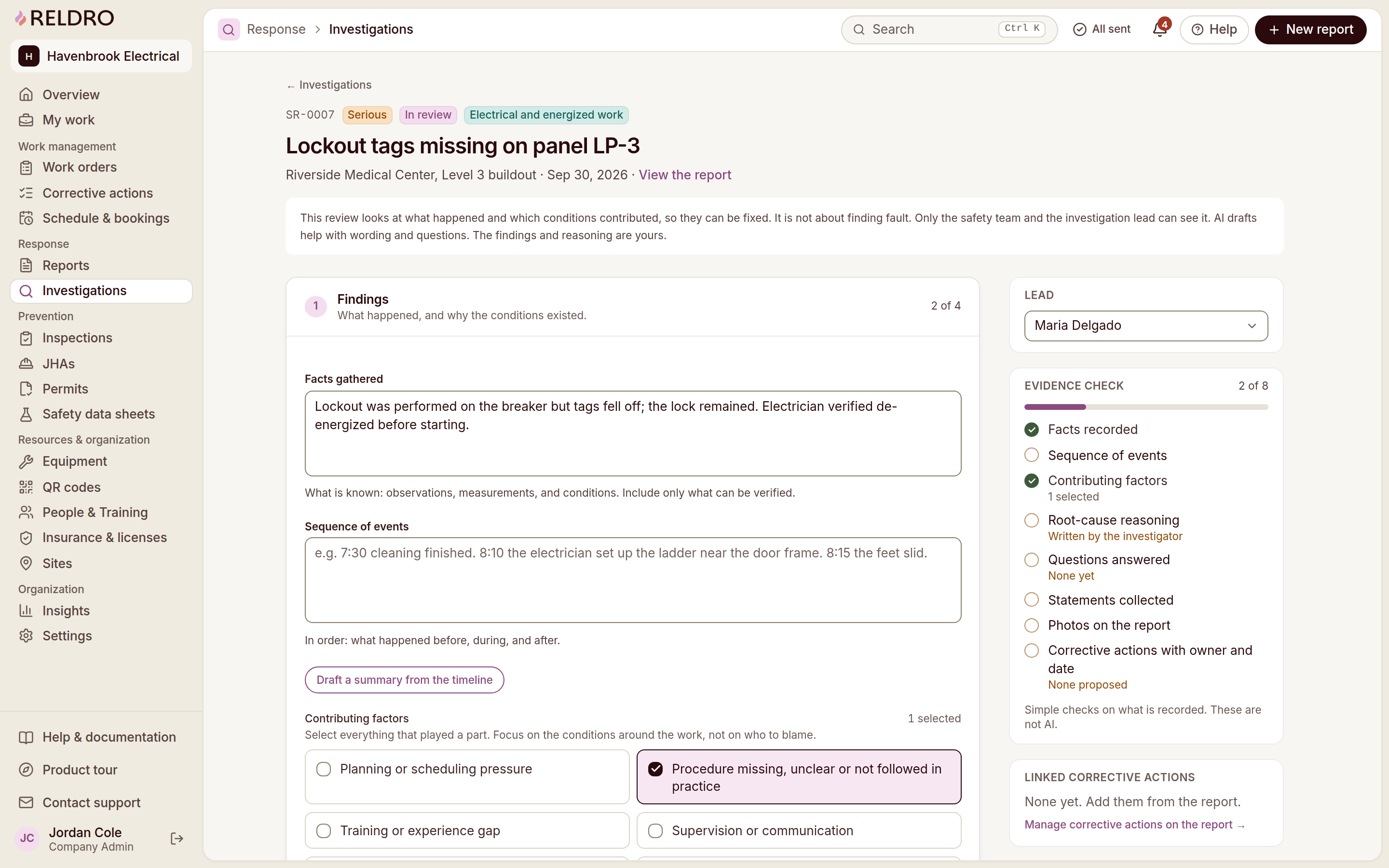
Investigation findings should come from the competent people reviewing the evidence. Software can organize facts, references, questions and drafts. It cannot establish a root cause merely by generating a confident explanation.
Reldro AI can suggest questions and draft investigation summaries for review when the relevant tool is enabled. Check every statement against the source records and retain uncertainty. Remove unsupported causal claims, invented chronology and details the records do not establish.
A useful review asks which evidence supports the finding, what alternatives remain and what information is missing. The answer should be understandable to a later reviewer without implying that the software independently tested or certified the conclusion.
Connect corrective actions without rewriting the event
An investigation may lead to several actions with different owners. Define the expected result, source finding, due date and verification method for each. Keep technical control selection with the appropriate reviewers rather than turn a generic recommendation into an unreviewed instruction.
Separate an action owner's completion update from the verifier's review. Evidence should match the item. If the outcome is not established, retain the open question and next owner rather than close the entire event to simplify reporting.
If an action changes, preserve its reason and history. A revised due date or scope should not erase the original finding. The event record, action record and final review need to remain connected but distinguishable.
Control access and sensitive information
Event records may contain personal information, sensitive accounts or commercial details. Determine access through your company's authorized roles and information-handling rules. Do not assume everyone involved in a project should see every attachment.
Evaluate the software with ordinary role permissions, not only an administrator account. Ask how review, sharing, correction and retention work for the information your company needs. Do not promise anonymity, confidentiality or a particular retention period without verifying the actual setup and applicable obligations.
When preparing a learning summary, include only information appropriate for that audience and retain the source investigation separately. Removing a name does not necessarily remove identifying context. The authorized reviewer should consider the complete material before distribution.
Test a complete administrative response record
Use a clearly labelled practice event with representative information and no real sensitive details. Have one person enter the observation, a reviewer request clarification, an authorized investigator record a reviewed finding and an action owner provide evidence. Ask a separate reviewer to read the history back.
Check what happens when the sequence is uncertain, a note needs correction or an action is returned for more evidence. Those ordinary exceptions reveal more than a demonstration with perfect inputs. Confirm the tool supports your requirements without claiming the practice exercise establishes legal readiness.
Reldro's full-platform trial can support this evaluation. Keep practice records distinguishable from genuine reports and do not submit fictional regulator notifications or create misleading customer evidence.
Record notification decisions without claiming the software made them
An event may raise company, contract or statutory notification questions. The applicable jurisdiction, circumstances and responsible roles determine those obligations. A generic software workflow should not tell every construction company to use the same threshold, recipient or time limit.
Identify the authorized person who reviews notification requirements and records the decision. Keep the basis, timing and any uncertainty in the appropriate restricted record. If specialist legal or regulatory advice is needed, document that route rather than let the first reporter make an unsupported determination from a dropdown.
A system may retain that a notification was made, but the entry is not independent proof that the correct recipient received all required information. Use your company's confirmation process. Distinguish prepared, sent and confirmed states where the actual workflow supports them, and do not invent a platform capability simply to make the record sound complete.
For evaluation, use a practice administrative scenario without sending real notifications. Ask whether the responsible reviewer can identify the required decision and supporting information. Keep the exercise separate from the production event register and any live emergency or legal reporting channel.
Prepare lessons without exposing the investigation unnecessarily
A learning summary should help the intended audience understand the reviewed lesson and relevant next steps. It should not reproduce every witness account, sensitive attachment or personal detail from the investigation. Decide the audience and review owner before copying information into a toolbox talk or presentation.
Retain the source investigation separately and identify the approved lesson material. If findings remain provisional, do not present them as settled facts. A general reminder can be useful without claiming an unconfirmed cause or naming a person whose involvement is not necessary to the message.
Reldro AI can draft lessons for review from recorded information when the feature is enabled. The supplied capability description says names are removed before lesson drafts are created. The reviewer still needs to assess other identifying context and the accuracy of the content. Removing a name does not make every account anonymous.
If a lesson leads to revised training, a changed task plan or an action, retain that follow-up as its own record with the appropriate owner. Sharing the summary is not proof the change was implemented. A useful learning handover connects the reviewed message to the work it is meant to influence.
Check the difference between an open action and an open investigation
An investigation review and its corrective follow-up may progress at different times. Establish how your company records those states rather than assume one close button means every outcome is complete. The responsible closer should be able to identify any outstanding action and who owns it.
If a new fact arrives after a review, follow the appropriate correction or reopening process and keep its source. Do not silently edit an earlier finding so the record appears to have always included the new information. Future readers need to understand the sequence of evidence and decisions.
During evaluation, ask the vendor to demonstrate an ordinary correction and an outstanding action after an investigation review. Confirm the actual status and permission behavior rather than assume all products operate identically. The aim is traceable review, not a universal closure rule.
A company-wide count of closed events may be useful for administration, but it cannot establish the quality of the underlying findings or that every corrective measure was verified. Keep links to the evidence and review basis so the people responsible can examine the records that matter.
Questions about event management and reporting
Is an event record the same as a legally required report? No. Applicable laws, contracts and company responsibilities determine formal reporting. A software entry is not proof those duties have been met.
Should every concern become an investigation? The appropriate response depends on the event and your procedures. Responsible people determine the route; a software category does not make that decision.
Can AI decide the cause? No. Reldro AI drafts and suggests for review. People evaluate evidence and own findings.
When can the record close? Establish that through your authorized review process, while keeping incomplete follow-up visible. Closure of one record should not make unverified actions disappear.
The takeaway
Keep observations, response decisions, investigation findings and verified follow-up connected without confusing their roles. Software supports the record; authorized people direct the response.
Sources and further reading
References for this article, published November 11, 2026. Product scope and requirements can change. Confirm details with the provider and your safety team. Guidance from a specific jurisdiction may not apply to your construction project.