
Prevention
Weekly site safety review: turn checklist findings into follow-up
Use a weekly site safety walk template to review recurring findings, assign follow-up and check outcomes across contractor teams, without confusing a site walk with a formal audit.
By Reldro · · 8 min read
Use the weekly walk to close the information gap
A weekly site safety review should tell you more than how many checklists were completed. It should help you understand what was observed, which issues keep returning, who owns the response and whether the previous response was actually checked. Begin with open items from the last review, then use the current walk to add evidence and identify new questions.
This guide is for safety managers, contractor supervisors and operations managers connecting site observations with follow-up. It describes a coordination workflow, not a technical inspection procedure or a certification of site conditions. Your safety team must define the appropriate scope, competent reviewers and any specialist inspections required for the work.
Keep a site walk distinct from a formal audit
A site walk looks at current conditions and work coordination. A formal audit examines the management process against defined criteria and evidence. The weekly walk can provide evidence for an audit, but completing it does not establish that the whole safety system was audited or that every requirement has been met.
For example, seeing a completed inspection record tells you a record exists. It does not by itself tell you that the inspector was appropriately qualified, the inspection scope was correct or the recorded outcome matches the current condition. Define what you are actually reviewing and refer specialist questions to the appropriate person. This distinction helps avoid a reassuring summary that says more than the evidence supports.
Prepare from the previous week’s open items
Before the walk, collect unresolved findings, actions due for review and changes in the work phase. You are looking for a useful route through the site, not a perfect report assembled before seeing the work. Include locations where previous findings remain open and areas affected by a new trade, delivery arrangement or work package.
Select a manageable sample of records where a process question needs checking. If a finding was marked resolved, identify the confirmation you expect to see. If the same observation appeared on two walks, check whether the location and circumstances are genuinely the same before labelling it a repeat. Similar wording can hide different problems.
- Bring the prior findings with their original locations and references.
- Identify actions awaiting verification, not just actions marked complete.
- Note changes to work areas and shared responsibilities.
- Agree who will join the walk and who will review specialist questions.
Choose a scope people can understand
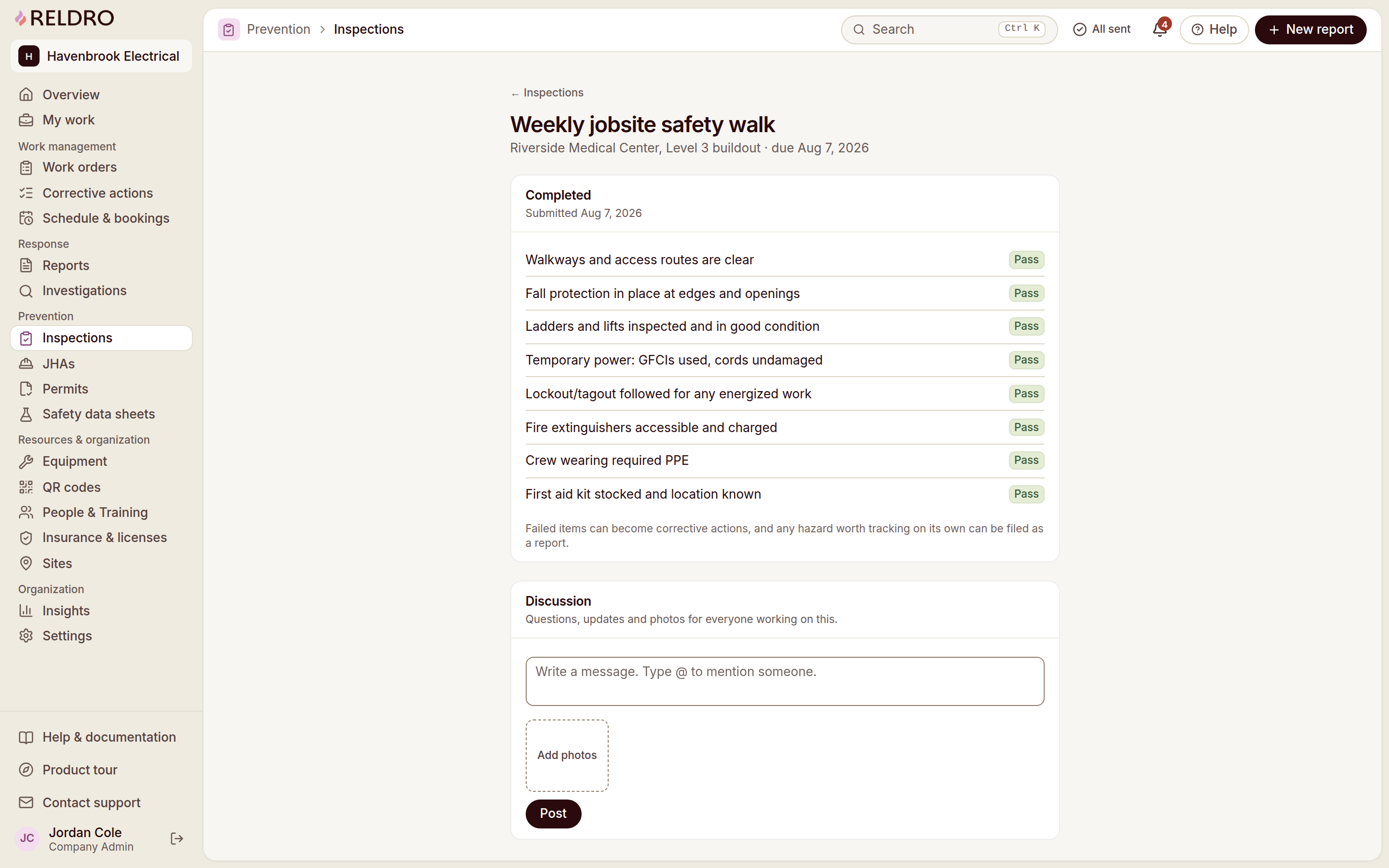
The public weekly template currently has eight prompts and includes reviewing previous open actions. Its suggested weekly routine does not determine the inspection frequency required for your work. Open the weekly site safety walk template and compare its prompts with your approved site arrangements. A template helps structure the conversation, but it cannot determine which technical checks apply to your project. Agree the scope with your safety team and make exclusions explicit. A general walk should not quietly replace a specialist scaffold, electrical or excavation inspection.
Use a stable set of coordination fields: site, date, reviewers, areas visited, observations, linked evidence and follow-up. Add site-specific questions when they support a real decision. If a prompt is outside the reviewer’s competence, capture the question and refer it. Marking it satisfactory to avoid an incomplete form hides the very information the review is meant to surface.
Record what you saw before deciding what it means
Write observations in language another supervisor can understand. “Poor housekeeping” expresses a judgement but gives the next person little direction. “Packaging material stored beside the planned delivery route on Level 1 west, observed during the afternoon walk” identifies the condition, place and time. Whether that condition requires a particular technical control is a separate decision for the relevant site process.
Keep observations, proposed actions and confirmed outcomes distinct. Where photographs are appropriate, include context such as area and viewing direction, and avoid unnecessary personal information. A picture of a changed arrangement is useful evidence of that arrangement; it is not automatically proof that every related risk has been addressed.
Worked example: the same delivery-route issue returns
Here is an illustrative example. Last week’s walk identified material occupying a delivery route. The action was assigned to a site logistics lead and later marked complete. On this week’s walk, a similar arrangement is recorded in the same location. Rather than simply reopening the old finding with a new date, the reviewer compares the two records.
The old record shows that the material was moved at the time. The new observation suggests the arrangement returned after another delivery. These are different facts: the previous action may have happened, while the process that led to the observation may still need attention. The reviewer records the current condition and asks the responsible lead to review why the arrangement recurred.
The next action might involve reviewing storage planning, responsibilities or the delivery sequence through the site process. The record should name the owner and the evidence expected at the next review. This example does not prescribe a technical remedy. Its purpose is to show why “closed last week” and “resolved for good” are not interchangeable conclusions.
Agree an owner, next step and verification
For each finding, describe the requested next step and identify one accountable person for coordinating it. Several teams may contribute, but “all contractors” is not a clear owner. Where an item spans organizations, agree who receives the issue and who confirms the outcome. OSHA’s US recommended practices discuss communication and coordination between employers; those practices are guidance, not a universal rule for every project.
Set the update or review timing through your site procedures and the appropriate judgement of the responsible people. This article does not provide a severity scale or deadline for safety responses. A serious concern must follow the approved response process rather than waiting for the next weekly meeting.
Define verification before the action is called complete. A message saying “done” may prompt a review, but it is not necessarily the evidence needed to confirm the outcome. Record who checked the result, what they checked and any remaining limitation.
Share a summary that preserves the open questions
A useful weekly summary separates new findings, items awaiting a decision, actions reported complete and outcomes verified. Include the relevant locations and owners. Avoid collapsing these into a single “passed” score that conceals an unresolved dependency. Your office planner needs to know which work may be affected, not just whether a form was submitted.
Give the field team the same practical information in a form they can use: what changed, who owns the next step and where the current instruction or record can be found. Confirm that cross-company handoffs were received where your process requires it. A report sent to a distribution list is not proof that the responsible person understood their action.
Compare sites without rewarding tidy paperwork
When you manage several projects, use consistent definitions for observation, action and verified outcome. That makes a record from one site understandable to a reviewer at another. Keep the local context: work phase, areas visited and scope can differ substantially. A site with more findings may have a broader review or more candid reporting, not necessarily worse conditions.
Start with process questions rather than rankings. Are findings missing owners? Are actions repeatedly reported complete without verification? Are reviewers unable to locate current records? Those patterns can point to a coordination problem worth investigating. Counts alone cannot establish causation or certify safety performance.
Check whether the checklist is helping after a few reviews
Pick one finding and trace it from the original walk to its latest status. Ask someone who did not write the report to explain the observation, requested action and remaining decision. If they need to reconstruct the story from disconnected messages, improve the references and handoff fields. Adding more questions to the walk will not necessarily fix that problem.
Ask reviewers which prompts were useful, which repeated another specialist record and which led to ambiguous answers. Revise the checklist through your approval process and keep the version clear. Preserve old findings and their context so a later review can understand the change rather than treating an edited template as evidence that earlier reviews used the new scope.
Use the weekly template alongside the daily workflow
The weekly walk is a chance to review patterns and follow-up, while the start-of-shift routine connects current assignments with current open issues. Link them through the same finding references where practical. An open item should not disappear between the weekly report and the next day’s plan.
Open the weekly site safety walk template and bring one previous finding to your review. Agree how it would be assigned, updated and verified. Reldro has inspection and corrective-action workflows that you can discuss using those records. The template is publicly readable; operational use leads to a demo request, not a promised free download or compliance certificate.
The takeaway
Use the weekly site walk to connect observations with named follow-up and checked outcomes. Keep specialist reviews separate, preserve open questions and investigate recurring patterns without treating a completed checklist as proof of compliance.
Sources and further reading
References for this article, published November 9, 2026. Product scope and requirements can change. Confirm details with the provider and your safety team. Guidance from a specific jurisdiction may not apply to your construction project.